Carriage Axis Motor Failure
This error indicates a problem with the motor responsible for moving the printhead carriage across the printer. It will prevent any printing operations.
- 1Faulty carriage axis motor
- 2Damaged or dirty encoder strip
- 3Broken or loose carriage belt
- 4Obstruction in carriage path
- 5Seized carriage bearings or worn carriage rod
- Carriage does not move or moves erratically
- Grinding noises from carriage area
- Printer stops during printing
- Print quality issues (vertical banding, misaligned prints)
- Error appears immediately on power-up
Video Guides
5 videosHP Designjet 500/800/510/500+Check/Replacement Carriage BushingsERROR 86:01 Carriage Axis Shutdown
More Videos

System error code: 86:01 on HP T790 T1300 T2300 Designjet Printer
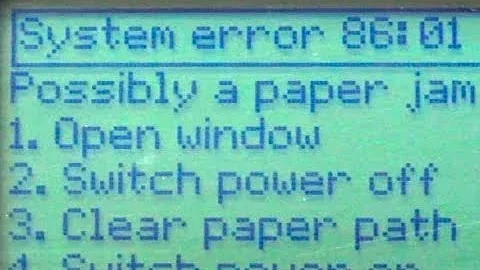
HP Designjet 500 & 800 Error 86:01 AFTER Belt Replacement

HP T830 Plotter Error Code 0042-0117 for full video check my youtube channel "BABA FIX" pl subscribe

Repair for HP Designjet 500/800/510/500+ Check/Clean/Replace Encoder Strip ERROR: 86:01/10/11-87:13
Get the full detailed repair guide with expert pro tips.
No signup required for basic access
Need Professional Help?
Chat with our AI assistant to get matched with a certified repair professional.
The component that deposits ink onto the media. DesignJet printers use thermal inkjet printheads that fire tiny droplets of ink through microscopic nozzles.
The mechanism that moves the printheads back and forth across the media during printing. It rides on a guide rail and is driven by the scan-axis motor via a belt.
The motor that drives the carriage assembly horizontally across the platen. It's responsible for the precise left-right movement of the printheads during printing.
A calibration process that ensures all printheads are precisely aligned relative to each other for accurate color registration and sharp output.
When the printhead physically contacts the media surface during printing, potentially damaging both the print and the printhead.
A print mode where the printhead deposits ink in both directions of travel (left-to-right and right-to-left), doubling print speed compared to uni-directional printing.